2014년 9월 5일 금요일

S.Korea, U.S. to Launch Combined Army Unit Next Year

S.Korea, U.S. to Launch Combined Army Unit Next Year

South Korea and the U.S. have agreed to launch a combined army unit next year to boost their defense capability.

The combined unit will consist only of a rump staff
but if war breaks out it could mobilize 10,000 troops from the 2nd U.S. Infantry Division and 2,000 from a South Korean brigade.

The unit will move with U.S. Forces Korea headquarters to Pyeongtaek, Gyeonggi Province in 2016.

Meanwhile, the two countries also agreed to keep the Combined Forces Command in Seoul,
but they have not yet decided whether it will stay at the present USFK headquarters in Seoul or at other facilities.

The combined unit will be led by the commander of the 2nd U.S. Division, with a South Korean brigadier general as his deputy.
The 30-strong rump staff will consist of South Korean and U.S. officers.

Its main duties would be repelling North Korean forces in the event of all-out conflict and destroying the North's weapons of mass destruction.

During the joint "Key Resolve" exercises, the USFK has regularly brought in a WMD demolition unit from the U.S. mainland.

The new unit will be headquartered in Uijeongbu, where the 2nd U.S. Division is stationed, prior to the relocation.

It "will contribute to a combined defense posture as joint exercises are carried out in peacetime and the combined unit comes into play in a war,"
a spokesman for the Joint Chiefs of Staff said.

The two countries are also in talks on whether to keep an artillery brigade of the 2nd U.S. Division north of the Han River.

"The U.S. military wants to keep the artillery brigade in Dongducheon, and the South Korean military also thinks that's a good idea
because it would strengthen its ability to respond to North Korean long-range artillery,"
a military source said. "But the plan has hit a snag because the local government and some citizens are against it."

A similar cloud hangs over the Combined Forces Command.
The U.S. wants to keep it at the Yongsan garrison,
but Seoul has already made extensive redevelopment plans for the site, which is to become a public park. 

2014년 8월 30일 토요일

日本が行くべき道

第二次世界大戦当事, 帝国主義的欲望によって,
ドイツそして日本この二国が犯した'人類最悪の悲劇'
しかしドイツにはあるけど日本にはないもの![過去に対する責任]。
日本とともに世界平和を壊し残酷な戦争を起こしたが
過去に対する全ての責任を負い犠牲者たちに心のこもった謝罪をし
むしろヨーロッパ統合と繁栄の中心に立つようになった国 'ドイツ'。
過去の暗い歴史を忘れずに記憶し反省して
二度と同じことが繰り返されないように責任を果たすこと
これがまさに日本が世界平和を守ることに参加した鍵ではないでしょうか。
過去の暗い歴史を忘れずに記憶し反省して二度と同じことが繰り返されないように責任を果たすことこれがまさに日本が世界平和を守ることに参加した鍵ではないでしょうか。

10 things South Korea does better than anywhere else

(CNN) -- For such a small country -- it ranks 109th in the world for total area, right behind Iceland -- South Korea sure is in the news a lot.

Occasionally that news is grim -- something to do with a troublesome cousin across the border.

Sometimes it's pure mainstream pop -- a bunch of cute singers taking down Lady Gaga on the world stage.

Sometimes it's just plain astonishing -- no one throws out the first pitch at a baseball game with as much panache as South Koreans.

From the weird to the wonderful to sci-fi stuff from a Samsung galaxy far, far away,
here are things South Korea pulls off more spectacularly than anywhere else.

More: 40 most beautiful places in South Korea 

1. Wired culture 


Want to see what the future looks like?

Book a ticket to the country with a worldwide high 82.7% Internet penetration and where 78.5% of the entire population is on smartphones (as of 2013).

Among 18 to 24 year olds, smartphone penetration is 97.7%.

While they're chatting away on emoticon-ridden messenger apps such as Naver Line or Kakao Talk,
South Koreans also use their smartphones to pay at shops,
watch TV (not Youtube but real-time channels) on the subway and scan QR codes
at the world's first virtual supermarket.

Hyundai plans on rolling out a car that starts with your smartphone in 2015.

Samsung in the meantime has been designing a curved phone.

Crazy displays of technology already in place but not yet distributed can be seen
(by appointment) at T.um, Korea's largest telecom company SK Telecom's future technology museum.

T.um, Jung-gu, Euljiro 2-ga 11, Seoul; +82 2 6100 0601

More: 50 reasons why Seoul is the world's greatest city 

2. Whipping out the plastic 


South Koreans became the world's top users of credit cards two years ago,
according to data from the Bank of Korea.

While Americans made 77.9 credit card transactions per person in 2011 and Canadians made 89.6,
South Koreans made 129.7.

It's technically illegal for any merchant in the country to refuse credit cards,
no matter how low the price, and all cabs have credit card machines.

All that flying plastic makes Seoul one of our top shopping cities in the world.

3. Workaholics 


South Koreans are so used to studying -- the country has the highest education level in Organization for Economic Co-operation
and Development (OECD) countries, with 98% of the population completing secondary education and 63% with a college education --
they can't get out of the habit once they reach the work force.

According to this quirky map from thedoghousediaries,
Brazil sets the standard for FIFA World Cup titles and North Korea leads in "censorship,"
but South Korea takes the crown for workaholics.

You can see it in any Korean city, where lights in buildings blaze into the late hours as workers slave away.

According to 2012 data from South Korea's Ministry of Strategy and Finance, South Koreans work 44.6 hours per week,
compared with the OECD average of 32.8.

And according to a study released in August 2014, along with Tokyo residents,
Seoulites get the least amount of sleep of any residents of major cities in the world,
just less than six hours a night.

4. Business boozing 


When they're not working, Koreans are celebrating their latest deals or drowning their sorrows in soju.

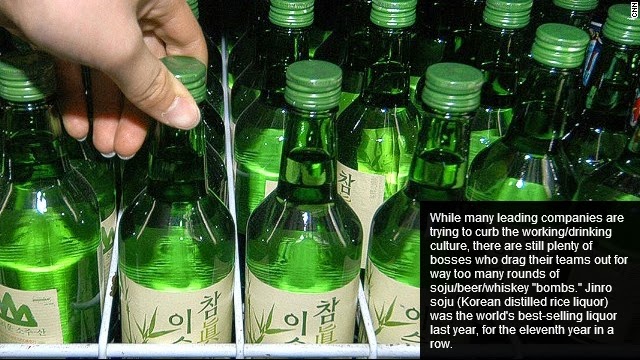
While many leading companies are trying to curb the working/drinking culture,
there are still plenty of bosses who drag their teams out for way too many rounds of soju/beer/whiskey "bombs."

More: Business traveler's guide to surviving a Korean drinking session

Those who opt out are considered rude or hopelessly boring.

Yes, Japan and a few other countries can stake reasonable claims to this title,
but South Korea has stats to back up the barroom brag.

Jinro soju was the world's best-selling liquor last year, for the eleventh year in a row,
with its home country accounting for most of the sales.

The South Korean distilled rice liquor manufacturer outsold Smirnoff vodka,
which came in second by 37.48 million cases.

More: 50 beautiful places to visit in South Korea

5. Innovative cosmetics


When it comes to makeup and cosmetics,
South Koreans can't stop experimenting with ingredients or methods of application.

Snail creams (moisturizers made from snail guts) are so 2011.

Now it's all about Korean ingredients such as Innisfree's Jeju Island volcanic clay mask and fermented soybean moisturizer.

At VDL, Korea's latest trendy cosmetics line, products change monthly.

Right now, they're pushing "hair shockers" -- neon tints for hair -- and nail polish with real flowers in it.

Just as Korean men are less wary of going under the plastic surgery knife (see point 10)
than their foreign counterparts, they also snap up skincare products and, yes,
even makeup, namely foundation in the form of BB cream.

South Korea is by far the largest market for men's cosmetics, with Korean men buying a quarter of the world's men's cosmetics --
around $900 million a year, according to Euromonitor.

More: Complete Korean cosmetics shopping guide

6. Female golfers 


The Economist posed a million-dollar question in 2013.

"Why are Korean women so good at golf?"

The rankings were staggering.

Of the top 100 female golfers in the world, 38 were Korean.

Of the current top 25, 9 are Korean
(10 if you count Seoul-born Lydia Ko, who calls New Zealand home).

Inbee Park, 25, is the second-ranked player in women's golf and was the youngest player to win the U.S. Women's Open.

In January, Ko, 14, set the record for the youngest woman to ever win a professional golf tournament.

Chalk it up to crazy Korean competitiveness or to the Tiger Mom/Dad theory
(golfer Se-Ri Pak's father is infamous for making her sleep alone in a cemetery every night to steel her nerves),
but the phenomenon certainly begs study.

Widely thought to be a response to Korean domination of the sport, the U.S.-based LPGA passed a requirement in 2008 mandating
that its members must learn to speak English, or face suspension.

7. Starcraft


One country's hopeless nerds are among another's highest earning celebrities.

Starcraft is actually a legitimate career in South Korea,
with pro gamers raking in hundreds of thousands of dollars in earnings in addition to endorsements.

Since the game launched in 1998, nearly half of all games have been sold in South Korea,
where boys, girls, men and women drop by for a night of gaming in giant video game parlors.

There are cable channels devoted solely to the games, and the culture has led to approximately 14% of Koreans
between ages 9 and 12 suffering from Internet addiction, according to the National Information Agency.

To try to crack down, the government passed a ban dubbed the "shutdown law" or
"Cinderella law" two years ago, prohibiting anyone 16 and younger from game websites.
The ban has been widely ignored.

More: How to be a Seoul local: 10 tips on faking it

8. Flight attendants


Flight attendants from airlines around the world come to Korean airlines' training centers to learn proper airborne charm.

Ask anyone who's ever flown a Korean airline and dare them to say the service isn't the best they've ever had.

It's not just the sweet smiles that greet every little request,
but the almost comical looks of suicidal despair when they somehow run out of bibimbap in the row before yours.

9. Blind dates

"When's your next sogeting (blind date)?"

That's one of the most frequently asked questions of any Korean single.

The standard answer is the epic horror story that was the last blind date,
often involving a crippling Oedipus complex or intolerable physical flaw.

Followed immediately by a chirpy, "Why, do you know someone you can set me up with?"

Due to the high volume of blind dates, when Korean make up their minds, they move quickly.

According to data compiled by South Korea's largest matchmaking company, Duo,
the average length of time of a relationship from the (blind) first date to marriage is
approximately 10.2 months for working people, with an average of 62 dates per couple.

In a survey conducted by Duo, working singles interested in marriage say they typically go on two blind dates a week.

They should know. Of the top four matchmaking companies in Korea (there are 2,500 companies in the country),
Duo has a 63.2% marketshare.

More: The real Gangnam Style: Beauty Belt, wedding town, 24-hour culture

10. Plastic surgery


Whether it's a lantern jaw, wide forehead or long teeth, there's no feature doctors can't beautify
in the Asian capital for cosmetic surgery.

Russians, Chinese, Mongolians and Japanese flock to South Korea on plastic surgery "medical tours,"
not only for the skill of the surgeons, but for the good deals.

"An average -- not excellent -- face-lift in the United States will set you back about $10,000," S
eoul National University Hospital plastic surgeon Kwon Seung-taik told CNN.
"But in Korea you can get the same service for $2,000 or $3,000."

CNN. By Frances Cha, August 29, 2014

2 Russian TU-95MS Bombers Stray into Korea's Air Defense Zone

Two Russian TU-95MS bombers intruded into Korea's air defense identification zone
over the East and South Seas during joint Korea-U.S. military exercises last week.

Two F-15K fighter jets were scrambled from an air base in Dageu on Aug. 21 when
the two Russian bombers flew into the zone, a military spokesman said.

"We understand that they were flying on patrol," the spokesman added.

The air defense identification zone is not recognized by international treaties but
set by individual nations as the boundary where foreign aircraft need to seek prior permission from the country that claims it.

In February, Russian aircraft also intruded into Korea's air defense zone during joint drills.

Last week, the Russian bombers also intruded into Japan's air defense zone.
Two F-15J fighters of the Japanese Self-Defense Force were scrambled in response,
a Japanese government spokesman said.

The TU-95MS has a range of 15,000 km and a maximum speed of 920 km/h and can carry nuclear weapons.

[Chosun.com] Aug. 28, 2014 11:05 KST

Japan defense budget request highest ever as Abe boosts military

Japan’s defense planners are seeking their biggest budget ever for the coming fiscal year to pay for stealth fighters, drones and a hi-tech submarine, as Prime Minister Shinzo Abe bolsters the military amid an intensifying rivalry with China.

The Defense Ministry on Friday requested a 3.5% increase to 5.05 trillion yen for the year starting next April. If approved, this third increase in a row will more than reverse the decade of cuts that Abe ended after coming to office in December 2012.

Abe, taking a more assertive stance on national security, has also ended a ban on Japanese soldiers fighting abroad and eased curbs on weapons exports.

By testing the constraints of Japan’s pacifist postwar constitution, Abe has angered some neighbors, especially Beijing, which accuses him of reviving the nation’s wartime militarism.

Japan, in turn, is wary of the rapid military buildup in China, which has overtaken Japan in recent years as the world’s second-biggest economy. Beijing’s military budget has jumped fourfold over the past decade to 808 billion yuan ($132 billion), nearly triple Japan’s.

In recent years, Sino-Japanese tensions have ramped up over the ownership of a group of uninhabited islets in the East China Sea. Patrol ships and military planes from both countries now routinely shadow each other in the area.

In an bid to better protect remote islands, Japan’s Defense Ministry wants to buy six F-35 stealth fighters from Lockheed Martin Corp as well as 20 P-1 patrol planes from Kawasaki Heavy Industries Ltd - a bulk purchase to cut per-unit cost.

The government says procurement reform, including bulk purchases for multi-year projects, will save 700 billion yen over five years.

In another request meant to patrol the waters plied by China, the ministry is seeking 64.4 billion yen for an upgraded Soryu class submarine that can stay submerged far longer than the boat of the same class it requested for this fiscal year for 20% less.

The new sub has a propulsion system using long-running lithium-ion batteries, replacing one that used liquid oxygen to run a diesel engine, allowing it to stay underwater for around two weeks. The new design allows a “significant extension to the submarine’s ability to stay submerged,” said a ministry official.

Australia has said it is interested in the Soryu design as a possible replacement for its Collins class subs, which need to suck air through a snorkel at the surface when they use their diesel engines while submerged.

Japan’s shopping list also includes unmanned surveillance planes and tilt-rotor aircraft that take off and land like a helicopter but fly like a plane, as Japan aims to boost its monitoring and troop-deployment capabilities.

The ministry does not specify which models of tilt-rotor aircraft and unmanned drones it has in mind because talks with potential suppliers are still going on, but the V-22 Osprey, built by Boeing Co and Bell Helicopter, is the only tilt-rotor plane in military use - including by U.S. forces in Japan.

Besides the cutting-edge weapons, the budget request is boosted by the planned replacement of aging government planes, used for purposes like the prime minister’s overseas trips - akin to the U.S. president’s Air Force One - with two of Boeing’s 777-300ER jets.

When expenses for the new government planes and costs associated with the realignment of U.S. forces in Japan are excluded, the budget request comes to 4.9 trillion yen, up 2.4% from this year.

The Defense Ministry is also eying North Korea, seeking its seventh destroyer equipped with the Aegis ballistic-missile defense system.

“We will fortify our system of defending the whole of our country continuously and in a multi-layered fashion against ballistic missile attacks,” the ministry said in a statement.

Much of the Japanese archipelago sits within the range of North Korea’s mid-range Rodong missiles. The ministry’s latest white paper calls Pyongyang’s military activity a grave destabilising factor for Japan and the rest of the world.

The submission of the initial budget request will be followed by a series of negotiations between the Defense and Finance ministries ahead of the compilation of the government’s budget bill at the end of the year.

2014년 8월 28일 목요일

日本は戦争犯罪者が立てた国だ.

日本は戦争犯罪者が立てた国だ.

なぜなら、現職首相 安倍晋三が言(い)うのを"A級戦争犯罪者は、祖国の礎"と認めたからだ.
したがって日本国民は戦争犯罪者の子孫だ.
国民全体を戦争犯罪)者の子孫にしてしまった現職首相 安倍晋三, 本当に立派な指導者だ.


次は朝日新聞の報道の原文だ.

首相、A級戦犯ら法要に哀悼メッセージ「祖国の礎に」
安倍晋三首相が4月、
A級、BC級戦犯として処刑された元日本軍人の追悼法要に自民党総裁名で哀悼メッセージを書面で送っていたことが朝日新聞の調べで分かった。

連合国による裁判を「報復」と位置づけ、処刑された全員を「昭和殉難者」として慰霊する法要で、
首相は「自らの魂を賭して祖国の礎となられた」と伝えていた。

メッセージを送ったのは高野山真言宗の奥の院(和歌山県高野町)にある「昭和殉難者法務死追悼碑」の法要。

元将校らが立ち上げた「追悼碑を守る会」と、陸軍士官学校や防衛大のOBで作る「近畿偕行会」が共催で毎年春に営んでいる。

追悼碑は連合国による戦犯処罰を「歴史上世界に例を見ない過酷で報復的裁判」とし、
戦犯の名誉回復と追悼を目的に1994年に建立。

戦犯として処刑されたり、
収容所内で病死や自殺をしたりした計約1180人の名前が刻まれている。
靖国神社に合祀(ごうし)される東条英機元首相らA級戦犯14人も含む。

[朝日新聞] 2014年8月27日05時37分

2014년 8월 27일 수요일

North Korea Building Missile Submarine

New intelligence raises fears of future underwater nuclear missile threat from Pyongyang

[Photo] North Korean leader Kim Jong Un stands on the conning tower of a submarine during his inspection of the Korean People's Army Naval Unit 167 in this undated photo released June 16, 2014 / Reuters

U.S. intelligence agencies believe North Korea is building a submarine capable of launching ballistic missiles, potentially increasing the threat posed
by the nuclear-armed rogue state.

A missile launch tube on a North Korean submarine was observed recently by U.S. intelligence agencies
and is raising new concerns about the missile and nuclear threat from the communist regime in Pyongyang,
according to two defense officials familiar with reports of the development.

Pentagon spokesman Lt. Col. Jeffrey Pool declined to comment on the North Korean missile submarine program.
“We do not comment on intelligence matters, but we do urge North Korea to become more transparent in their defense sector in order to
reduce tensions in the region,” he said in a statement.

Details of the missile submarine remain closely held within the government.

Disclosure of the missile submarine work followed a recent report from North Korea showing photographs of dictator Kim Jong Un riding
in the conning tower of a rusty North Korean submarine at sea.

Military analysts expressed surprise at the intelligence on the missile submarine program and speculated the submarine could be a modification of
one of North Korea’s Russian or Chinese design Romeo-class diesel submarines.

A second possibility is that the new missile submarine is a copy or modification of a Soviet-era Golf-class missile-firing submarine purchased
by Pyongyang—ostensibly for scrap metal—in the mid-1990s.

North Korea’s current submarine force includes around 70 submarines.
Most of the vessels are older diesel submarines, including 22 Romeo-class or
Chinese design Type-031 subs—the type of submarine Kim was photographed on in June.

The majority of the North’s submarines, more than two dozen, are small, Sango-class mini-submarines used for covert commando operations
to infiltrate South Korea during a conflict.
The North Koreans also have four 1940s-design Whiskey-class submarines from Russia.

North Korea’s use of submarine warfare was evident as recently as 2010, when it carried out a torpedo attack on
South Korea’s Choenan costal warship, killing 46 sailors.

A North Korean mini-submarine is suspected in that attack. North Korea denied it was behind the strike.

Additionally, U.S. intelligence agencies believe North Korea already has submarine-launched ballistic missiles (SLBMs).

The North covertly obtained several SS-N-6 SLBMs from Russia.
The missile has been adapted into North Korea’s new intermediate-range missiles.

Until the recent discovery of the modified submarine, there were no intelligence signs North Korea is interested in developing
its own submarine-launched missiles.

Pyongyang is one of the largest producers and exporters of ballistic missiles in the world, and makes several types of short-range Scuds,
medium-range Nodongs, Musudan intermediate range missiles, and long-range Taepodongs.

Its missile arsenal is estimated to include between 600 and 1,000 missiles.

If the modified submarine is based on the Golf, it is likely the technology or
actual missile tubes were derived from the decommissioned submarines obtained in the mid-1990s.

The authoritative Jane’s’ Fighting Ships revealed in May 1994 that North Korea purchased 40 decommissioned submarines from Russia,
including several Golf-class and Romeo-class submarines.

Former British Navy Capt. Richard Sharpe,
stated in the foreword to the 1994 publication that the Golf submarine sale raised concerns about their missile capabilities.

It is “possible that the missile tubes may be adaptable for other weapons,” including ballistic missiles, he stated.

Rick Fisher, a military analyst, said he suspects one of the Golf-class submarines obtained by the North Koreans included
one or more SS-N-6 missiles in its launch tubes as part of the deal.

North Korea then may have used the past 20 years to reverse-engineer a version of the Golf,
which was designed to carry up to three ballistic missiles, Fisher said.

“In North Korean service, a Golf-size ballistic missile-carrying submarine could potentially carry two Musudan-size liquid-fueled missiles or
 a larger number of long-range cruise missiles,” he said.

If the missile submarine development is confirmed,
it would mean North Korea could use one of its submarine missiles to attack Anchorage from waters near Russia’s Sakhalin Island.

Another potential target for the North Korean missile submarine could be U.S. forces on Okinawa, Philippines, or Guam from the Yellow Sea.

The missile could have a range of between 1,500 and 2,500 miles.

Eric Wertheim, an analyst at the U.S. Naval Institute, said he is skeptical North Korea could develop missile firing submarines,
either indigenously or by copying or refurbishing a Golf.

“There are very many hurdles that would need to be overcome for North Korea to develop an SLBM and turn a diesel submarine
into an operational platform able to launch guided SLBMs,”
Wertheim said in an email.

“If not a Golf class, launch of SLBMs would probably require another large class of submarine and
most recent North Korean submarine production seems to have focused on smaller subs or less than 1,000 tons,” he added.

A former intelligence analyst also said North Korea’s refurbishing of the Golf subs would be very difficult,
and that the North Koreans would need satellite navigation for the missile.

South Korea press reports,
however, have indicated recently that China is sharing its Beidou satellite navigation technology with North Korea.

A 2009 State Department cable made public by Wikileaks revealed that North Korea developed
a new land-mobile intermediate-range missile based on the SS-N-6 SLBM.

The missile was deployed on Russia’s Golf submarines, indicating that the Golf missile tubes could be used or
copied for the new North Korean missile submarine or as launch tubes on a converted submarine.

A modified SS-N-6 engine was used to build what is now called North Korea’s road-mobile Musudan missiles.

“Development of the Musudan with this more advanced propulsion technology allows North Korea to build even longer-range missiles—or
shorter range missiles with greater payload capacity—than would be possible using Scud-type technology,”

the cable on North Korean missile development stated.

A second 2011 cable revealed that North Korea shared the SS-N-6 missile technology with Iran for use in its Safir missile.

The cable said
“the second-stage of the Safir utilizes steering engines that are almost certainly
derived from the Soviet-era SS-N-6 (Soviet designation: R-27 or RSM- 25) submarine-launched ballistic missile.”

“U.S. information was clear that Iran purchased these [missiles] from North Korea
and that its technology was far more advanced than SCUD technology,”
a third cable from 2007 said.

That cable quoted Russian officials, in talks with U.S. officials, denying any SS-N-6 missiles were sold to North Korea,
claiming all were destroyed as part of the 1987 Intermediate-range Nuclear Forces treaty,
which the State Department recently said was violated by Moscow through development of a new cruise missile.

Additionally, the Russians in 2007 said North Korea and Iran could not master the technology of the SS-N-6.
“The Russians argued that the technology was customized for underwater use;
and that the missile would not work without the water pressure at specific depths,” the cable said.

Fisher said another possible source for North Korea’s submarine-launched missile program is China,
which has produced a version of the Golf known as the Type-031 and which was used until 2013 as an SLBM test platform.

“Given China’s habit of assisting North Korea to obtain earlier generation strategic weapons, the chances are greater that
China would have aided North Korea’s rebuilding of the scrap Soviet Golf class submarines,”

Fisher said.
“Chinese assistance would have been crucial for North Korea to rebuild the pressure hull,
 missile tubes and to equip the sub with modern command and control systems.”

Fisher noted covert Chinese missile assistance in the past to North Korea’s KN-08 long-range missile,
specifically the transfer of Chinese-made transporter-erector launchers.

“The emergence of a North Korean ballistic missile carrying submarine raises many questions for U.S. strategy and force levels in Asia,”
Fisher said.

“Should it now be considered a great error for the Obama administration to have retired and
dismantled U.S. nuclear-armed cruise missiles for U.S. submarines in 2010?”

A missile-firing North Korean submarine also will require increased U.S. and Japanese anti-submarine warfare forces,
he said. “Both will have to consider an additional number of submarines to check North Korea,” Fisher said.

Another concern is that North Korea will share or export missile-firing submarines in the future to Iran.

North Korea cooperated with Iran on submarine training in the past.

[Source] Washington Free Beacon by Bill Gertz/August 26, 2014 5:00 am